The sales landscape is shifting. Companies that once relied on large outbound call centers are turning to AI calling agents for first contact, lead qualification and appointment setting. This article explains what is driving that change, what the technology actually does, and how to introduce it without disrupting a working sales process.
What an AI calling agent is
An AI calling agent (also called an AI voice agent or AI phone agent) is software that makes and receives phone calls and holds a real conversation. It combines three layers: speech recognition that transcribes the caller in real time, a large language model that decides what to say based on your scripts and data, and text-to-speech that answers in a natural voice. Unlike an IVR menu (“press 1 for sales”), it understands free-form speech, asks follow-up questions and takes actions such as booking a meeting or updating a CRM record.
1. Speed to lead in seconds
Source: MIT / InsideSales Lead Response Management study.
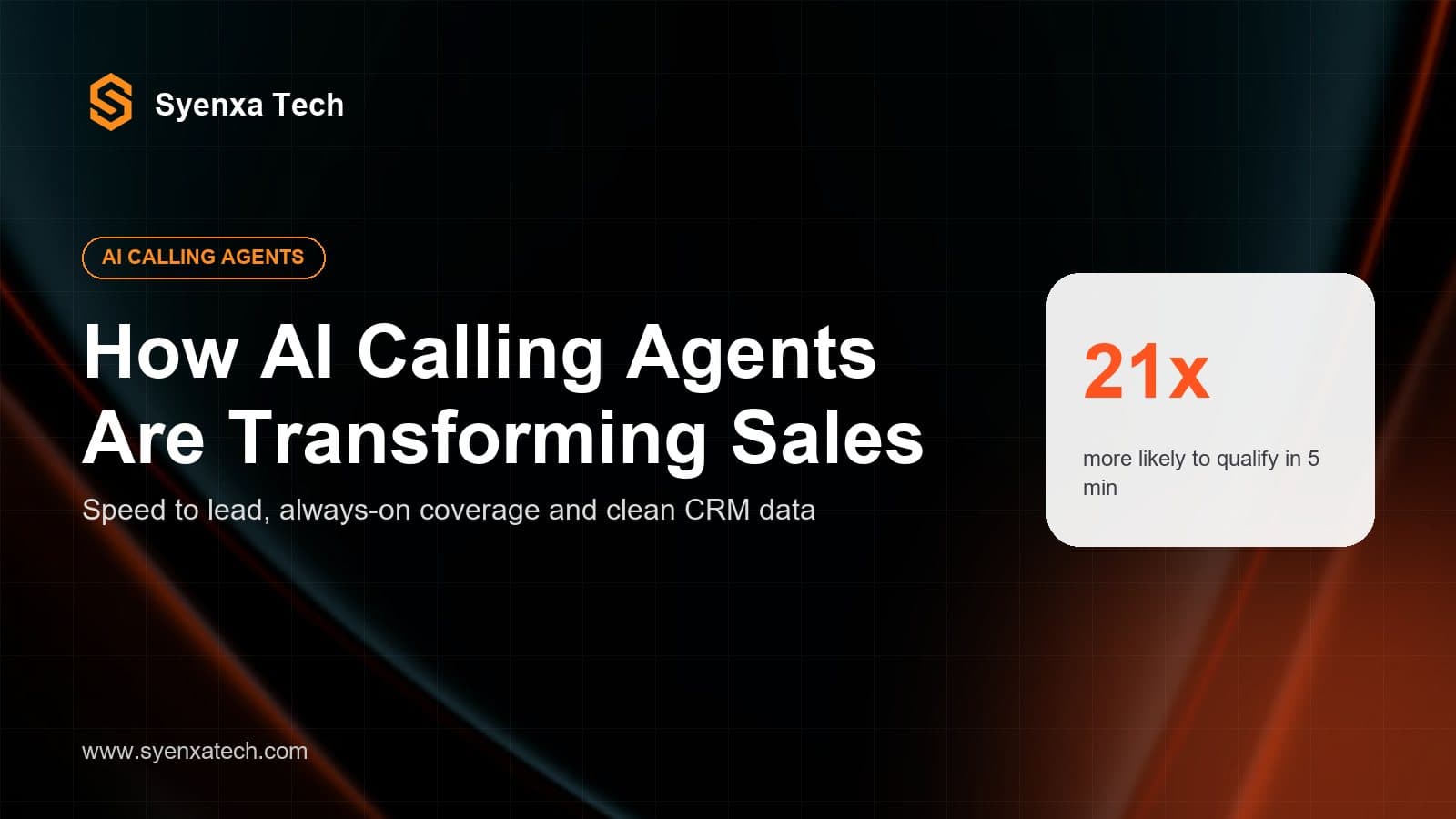
A lead's value drops sharply after the first few minutes. Research on speed to lead consistently shows that businesses that respond within five minutes convert several times more often than those that respond in an hour. Most sales teams cannot hit that window at 9 pm on a Friday. An AI calling agent can: it dials a new web-form lead within seconds, confirms interest and offers a meeting slot while the prospect is still thinking about the problem.
2. Natural, human-like conversations
The robotic text-to-speech of a few years ago is gone. Current voice models respond in well under a second, handle interruptions, and adapt tone to the caller. Syenxa Tech agents are trained on your real call transcripts and objection handling, so they sound like your best salesperson on a good day, not a generic bot. When a conversation goes beyond the agent's brief, it transfers to a human with a summary, so the prospect never repeats themselves.
3. Lower cost per conversation
Hiring, training and retaining a sales development team is expensive, and capacity is fixed. An AI agent handles hundreds of simultaneous calls for a setup fee plus per-minute usage, so cost scales with results rather than headcount. Most of our clients keep their closers and redeploy the time they used to spend on unqualified calls.
4. Coverage outside business hours
Evenings, weekends and holidays are when many consumers research services. Every call that goes to voicemail is a lead that may call the next provider. A voice agent answers every inbound call 24/7, in multiple languages, and books straight into your calendar. For industries such as dental clinics and real estate, after-hours coverage alone often pays for the system.
5. Clean CRM data by default
Because the agent runs the same qualification script every time, every record in HubSpot, Salesforce or GoHighLevel arrives with budget, timeline, decision maker and a full transcript. Sales managers get consistent data for forecasting without chasing reps to update fields.
How to roll one out
- Pick one workflow. Inbound lead qualification or missed-call follow-up is the usual starting point.
- Write the brief from real calls. Use transcripts and your top rep's objection handling as the source material.
- Connect calendar and CRM. Booking and logging are where the ROI lives.
- Define the handoff. Decide when the agent transfers to a human and what summary it passes along.
- Review weekly. Listen to a sample of calls and refine prompts. Most agents reach a stable quality level within two to three weeks.
When a voice agent is the wrong tool
Complex enterprise negotiations, sensitive complaints and regulated advice should stay with people. The sweet spot for AI calling agents is high-volume, repeatable conversations: first contact, qualification, scheduling, reminders and follow-ups. If that describes a large share of your team's day, see how our AI calling agents work or book a live demo on your own scripts.